Gåshamna
Sør-Spitsbergen National Park – Gåshamna is “goose bay” in Norwegian.
Last update: 30. June 2026
During the large Russian Arc of Meridian Expedition in 1899-1900, the scientists were making trigonometric measurements in Gåshamna and made what was considered a sensational discovery of the time. The scientists worked over large areas, measuring the distance between latitudes and determined the earth was flattened at the Poles.
Download PDF
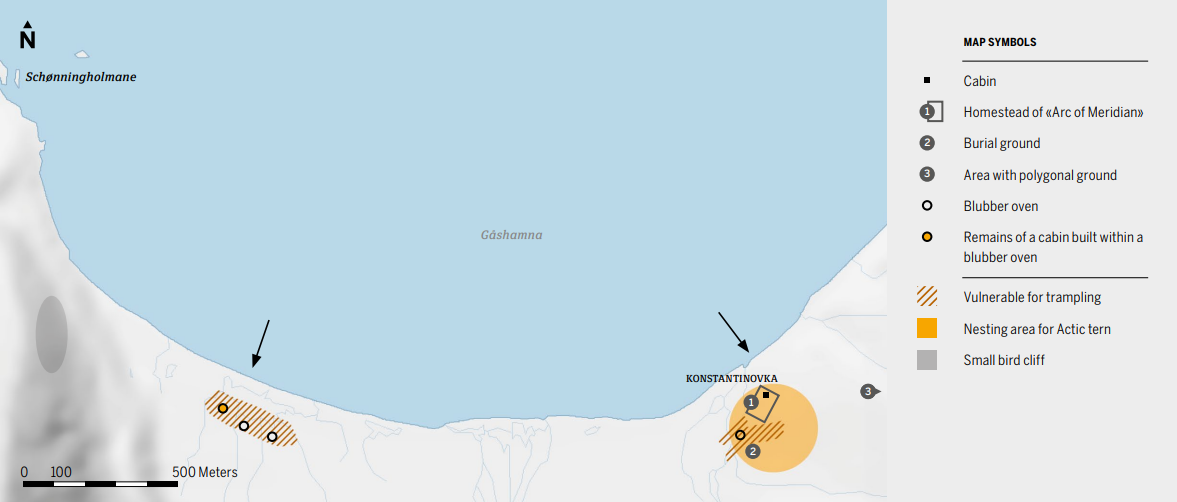
76°56.6’N 015°50.9’E
Vegetation
Gåshamna is barren with a few plant species scattered over the gravel and sand. Next to the cultural remains are green spots of vegetation, due to the supply of nutrients from human whaling and hunting activities of the past.
Fauna
This area holds relatively few species and low numbers of animals and birds. A few pairs of Arctic tern, Arctic skua and common eider breed here.
Cultural Remains
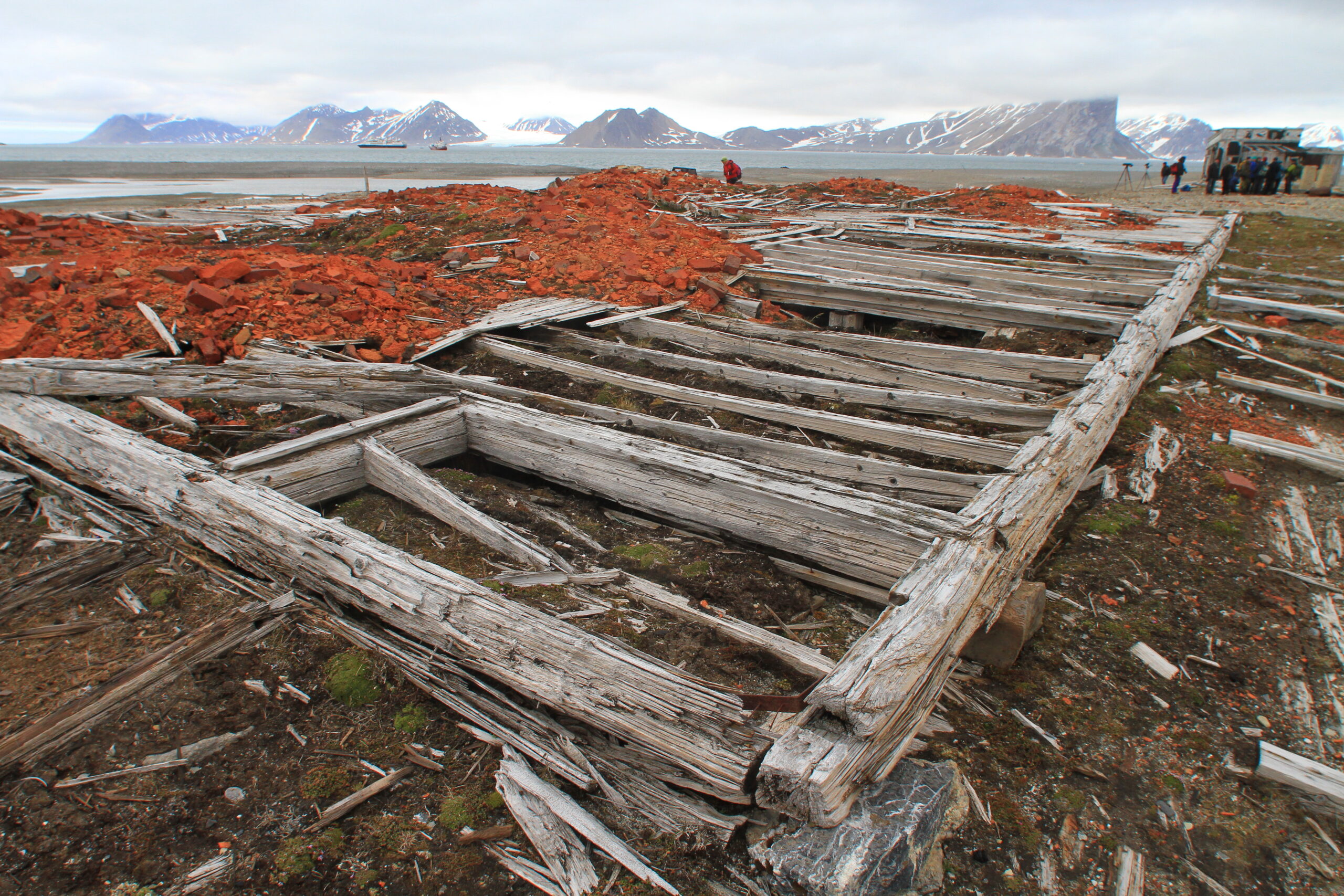
The ruins of the large Russian research station built for the Arc of Meridian Expedition appear as colorful spots in a grayish landscape. The remains include a residence, laboratory and an observatory. Later, a small cabin for Norwegian overwintering trappers was built within the remains of the station and was named Konstantinovka. Fragments of two large 17th century English whaling stations with their blubber ovens flank the river delta. Most creative is perhaps the Norwegian trapper`s cabin built of whale bones and crates within the remains of a blubber oven.
Guidelines
- The moss carpet surrounding the blubber ovens and the whalebones are fragile. Walk carefully and minimise trampling on vegetation by walking on the barren soil.
- When visiting the whaling burial ground, enter from the eastern side to avoid erosion in the steep slope.
- Observe the house ruins and blubber ovens from a perimeter and avoid tramping on them.
- If the terns attack, walk away while watching where you step to avoid trampling on eggs and chicks
- There are many protected movable historical objects on the ground. Watch where you step to avoid trampling on them. Do not pick up, re-arrange or remove any objects belonging to cultural remains.
Tip
On the ridge east of the ruins is a large area with polygonal ground.
AECO’s site-specific guidelines are reviewed by the Governor of Svalbard and funded by Svalbard Environmental Protection Fund.