Smeerenburg
Smeer (Dutch), meaning speck or blubber, accordingly the name means blubber town.
Last update: 04. November 2025
”Blubber town” was the main base for Dutch whaling in the first half of the 1600s. The blubber produced oil for lighting, paint, soap and other products in demand, in the increasingly-expanding urban Europe. Contrary to the myth of 20 000 inhabitants and a hectic party-life in Smeerenburg, the reality was 200 hard-working men in a growing oil industry at almost 80° North.
Download PDF
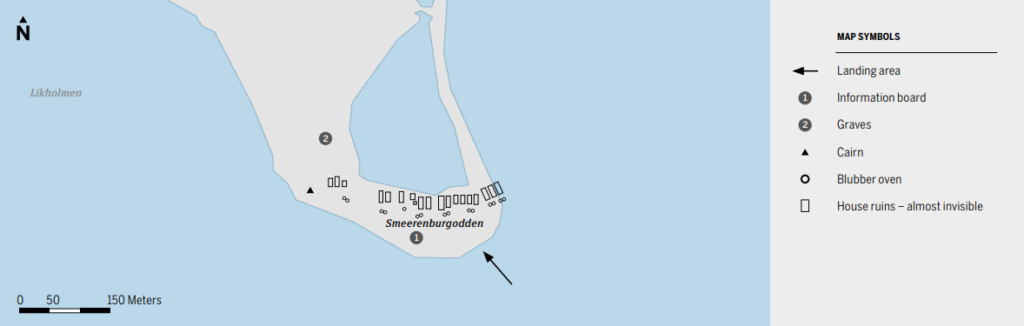
79°43.9’N 010°59.7’E
Vegetation
The main part of Smeerenburg was built on fine-grain sand. Most probably there was no vegetation here during the whaling period, but over the years a thin moss cover has developed. Behind the outer plain is a large vegetated area with polygonal ground, perfectly sorted with wet clay in the center, surrounded by larger stones.
Fauna
Common eider and Arctic tern breed close to the shore. Arctic skua and probably also great skua breed on the flat inland area. This is a feeding and moulting area for barnacle goose. Several species of waders, including ringed plover, ruddy turnstone, purple sandpiper and sanderling inhabit the area. Harbor seals are residents in the area and can often be seen resting on stones near the shore. Walrus, reindeer, polar bear and Arctic fox may frequent the area.
Cultural Remains
The most visible traces after the whaling station of Smeerenburg is the “concrete” from the 12 remaining blubber ovens. The asphalt-looking mass was formed by the greasy whale oil, which was blended with sand and gravel. Long after Smeerenburg was abandoned, it was still used as a harbor of refuge, equipment storage, a rendezvous for whale boats in the spring and autumn and as a burial ground. 101 graves are found in the area.
Guidelines
- Stay on the beach as long as the area is snow-covered and wet in order to avoid unintentional trampling on the cultural heritage remains and damage to the vegetation.
- Observe the remains of the blubber ovens and the graves from the perimeter.
- The small pieces of blubber concrete are also protected and must not be touched.
- The house remains from the whaling station are almost invisible. Watch your step.
- Retreat if terns and skuas attack while watching were you step to avoid trampling on eggs and chicks.
- Avoid landings and traffic in areas with large numbers of eiders and geese.
- Approach areas with family groups of eiders and geese carefully. On land, keep the group
- of visitors together and walk slowly. Disturbance during breeding and moulting season may cause chicks being separated from the adults, making them easy prey for glaucous gull and Arctic fox.
- The polygonal ground behind the plain is muddy, partly very muddy. Walking in the area could cause visible footprints.
Tip
Smeerenburg is one of the northernmost places where harbor seals are often seen.


AECO’s Site-Specific Guidelines Are Reviewed by the Governor of Svalbard and Funded by